
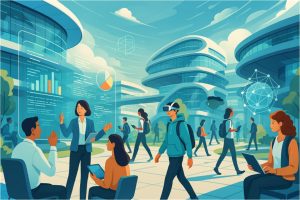
Higher education is undergoing a profound transformation. The “University of the Future” will not simply be a digital version of today’s campus, it will be an interconnected, adaptive ecosystem powered by intelligent systems and ultra‑reliable network connectivity. In this 3-part blog series, we’re exploring what that future might look like, how it could operate, and above all why high‑performing digital services sit at the core of its success.
In part 1 we looked at what the University of the Future looks like, and in this part 2 we’ll move onto how it operates.
Part 2: How the University of the Future Operates
The operational model of the future university is radically different to that of today. It’s driven by data, automation, artificial intelligence, and continuous connectivity.
Digital-First Administration
Administrative processes are automated and streamlined. From enrolment to assessment, everything is digitally managed. Trusted credentials ensure secure, verifiable academic records that students can share globally.
AI-powered assistants support both students and staff – answering queries, scheduling resources, and providing real-time guidance. This reduces administrative burden and allows educators to focus on teaching and mentoring.
Continuous Learning Ecosystem
Education is no longer a one-time experience. Universities operate as lifelong learning platforms, offering modular courses, micro-credentials, and just-in-time training. Alumni remain connected to the university ecosystem indefinitely, returning to upskill as needed throughout their careers.
Data-Driven Decision Making
Every interaction within the university generates data – learning patterns, resource usage, engagement levels. Institutions leverage this data to continuously improve curriculum design, teaching methods, and student outcomes.
For example:
- Students at risk of falling behind are identified early and given targeted support.
- Courses are refined in real time based on engagement analytics.
- Facilities and resources are optimised using usage patterns.
Seamless Collaboration with Industry
The future university operates in close partnership with industry. Projects, internships, and research initiatives are deeply integrated into academic programs. Employers co-design curricula to ensure graduates are job-ready, while students gain hands-on experience solving real-world problems.
Conclusion
The University of the Future operates as a seamless, data-driven ecosystem where learning, administration, and industry collaboration are fully integrated. Powered by automation, AI, and continuous insight, it shifts from one-time education to a flexible model of lifelong learning. Institutions evolve in real time, adapting to student needs, workforce demands, and global change, with agility and precision.
Keep an eye our for Part 3 where we’ll examine the critical role high-performance network connectivity plays in enabling the University of the Future.